Dictation for wrist pain: a setup that spares your hands
If your hands are the reason you are reading this, the setting that matters most is not the speech model. It is the trigger. Dictera's defaults already put every action on a single modifier key, and with two changes a whole paragraph costs one tap - or none, if you would rather use a foot switch.
What dictation actually takes away
A page of writing is a few thousand keystrokes. Dictated, those words cost one key press, and the rest of the work moves to your voice. That is the whole of the benefit, and it is a large one if typing is what hurts.
It is worth being clear about what stays. Dictation does not move your cursor, click a button, switch apps, or select the sentence you want to fix. Those are still hands, and on a bad day they are the hands that hurt. What follows is about making the part Dictera does own as cheap as possible, and being honest about the rest.
This is a keyboard setup, not medical advice. Repetitive strain has causes a shortcut cannot reach, and pain that is new, persistent or numb is a reason to see a clinician rather than to change a setting.
Make the trigger as small as possible
One key, never a chord
Dictera's shipped shortcuts are all single modifier keys, deliberately. Dictation is the right Command key, held. Translating a dictation is the same key, tapped twice. Edit Selection is the right Shift key, held; Correct Selection is a double-tap of the right Option key. Nothing asks you to hold three keys and reach for a letter at the same time, which is the shape of shortcut that hurts.
You can change any of them, and the thing worth keeping when you do is the single-key part. A chord you press two hundred times a day is worse than the typing it replaced.
Hold or tap
The hold mode - push-to-talk - keeps a key down for the length of the recording. It is the tidiest mode, because nothing can be left running, and it is the wrong one if sustained pressure is your problem. A paragraph is thirty seconds of holding a key with one finger.
The double-tap costs two taps at the start and two at the end, with nothing in between. If holding is what aches, switch. Settings ▸ Shortcut takes about a minute, and the three modes and their trade-offs are worth reading once before you pick.
The side that hurts less
Modifier keys come in pairs, and Dictera can listen to the left key, the right key, or either. If one hand is worse than the other, bind dictation to the good side and it will never be asked to do the work. Sticking to the right-hand keys has a second benefit: the left Command key stays free for ⌘C and ⌘V, and an ordinary double-tap during editing cannot start a recording by accident.
One tap for a whole paragraph
Two settings together turn a dictation into a single gesture. Set the shortcut to double-tap, then turn on stop on silence, which is off until you ask for it. Dictera watches the input level while you record; once you have spoken for at least a second and then been quiet for two, it ends the recording and writes the text out.
The result is that you tap twice, talk for as long as you like, and stop. Your hands never come back. For a long email that is the difference between one gesture and about fifteen hundred.
Three dials sit behind it, in Settings ▸ Voice. The one to change first is the silence timeout: two seconds suits someone who speaks in finished sentences, and if you pause to find a word, raise it to three or four. Otherwise the pause ends the recording and the rest of your thought arrives as a second dictation, cleaned up separately, with a paragraph break you did not ask for. If your room is noisy, raise the level that counts as voice rather than the silence, so the background does not hold the recording open forever.
Or no tap at all
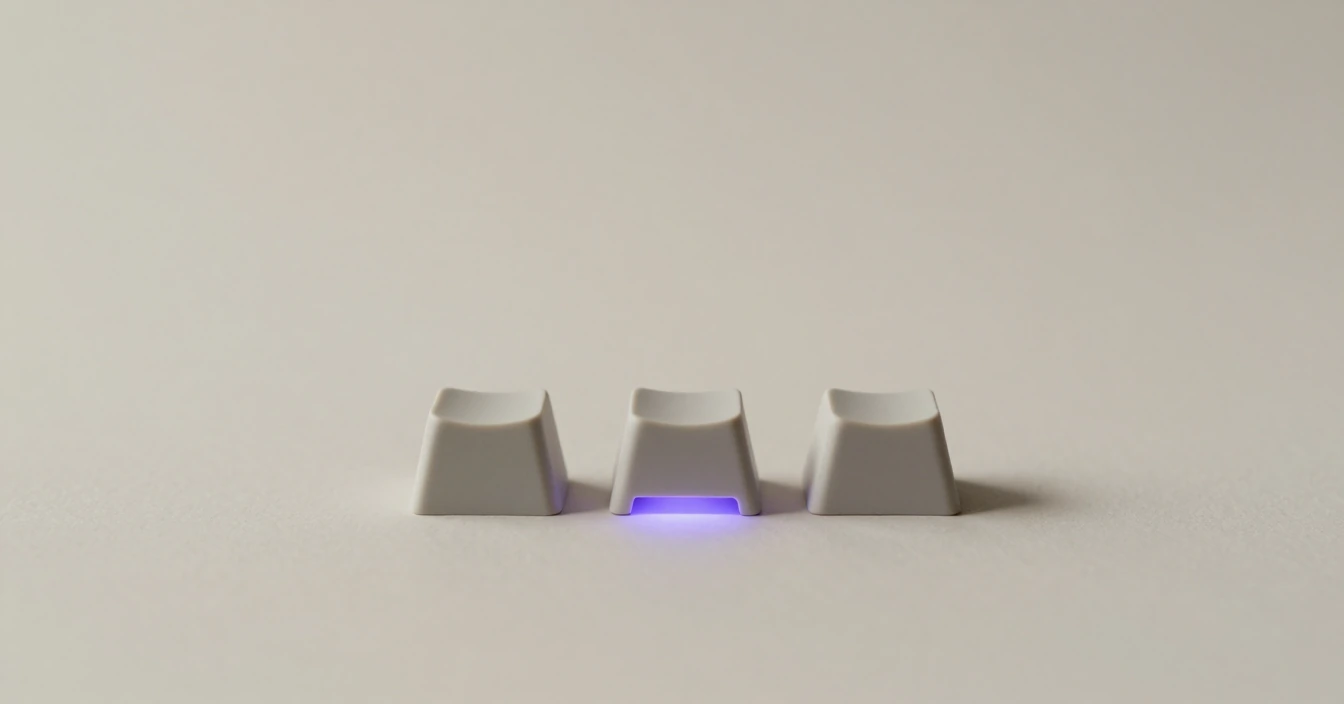
The third shortcut mode is an ordinary key combination, and its usefulness here is that Dictera does not care what pressed the key. Anything that sends one works: a spare key on a programmable keyboard, a macro pad under your palm, a foot switch. Bound to a pedal and paired with stop on silence, a dictation costs your hands nothing at all.
There is also a route with no keyboard in it. Dictera's menu bar item has Start Transcription at the top, so a mouse, a trackball or a head pointer can begin a recording the same way the shortcut does. It is slower than a tap, and on the days when it is the only thing that does not hurt, that is fine.
The keys you press after the words land
Return, comma, full stop, the arrow keys taking you back to fix something - the small presses add up, and most of them are avoidable.
- Say the structure. "New line" and "new paragraph" insert the breaks, so you never reach for Return mid-dictation. Voice commands are on by default.
- Do not say the punctuation. You can - "comma", "question mark", "colon" all work - but the on-device cleanup model punctuates what you said anyway, so saying every mark out loud is effort spent for a result you already had.
- "Scratch that" throws the dictation away, so a sentence that came out wrong does not have to be deleted by hand. It only fires when it is the whole of what you said; halfway through a paragraph it is just words.
Fixing text without retyping it
The expensive part of writing with sore hands is rarely the first draft. It is the fifty small corrections afterwards, each one a click, a drag and a dozen keystrokes.
Three shortcuts work on whatever is selected, anywhere on your Mac. Correct Selection fixes grammar, spelling and punctuation in place, in one undoable edit. Edit Selection records a spoken instruction instead - hold the key and say "make it shorter" or "turn this into bullet points" - and the rewrite replaces the selection. Translate Selection shows a translation in a floating panel without touching the document. All three are on the features page in more detail.
The honest caveat is that they all start with a selection, and selecting is hands. ⌘A for a whole field costs one press; ⇧ with the arrow keys costs many. Where you can, dictate into an empty field, correct the whole of it, and move on - that is one selection instead of five.
What this does not fix
Dictera writes. It does not drive the Mac. There is no way to say "click send", scroll a page, or move the cursor two words left, and there is no spoken backspace: dictation appends, and a correction is a selection plus one of the shortcuts above.
The tool for the rest of it is already on your Mac. Voice Control, in System Settings ▸ Accessibility, moves the pointer, clicks, and navigates by voice, and it is a different job from turning speech into good prose. Using one for writing and the other for navigation is a reasonable arrangement, and neither is a substitute for the other.
The setup, in four changes
- Shortcut mode to double-tap, on the side of the keyboard that hurts less.
- Stop on silence on, with the silence timeout at three seconds if you pause to think.
- Voice commands left on, and the habit of saying "new paragraph" rather than reaching for Return.
- Correct Selection and Edit Selection kept for the fixing, so corrections cost a selection rather than a retype.
None of that is a treatment, and none of it makes a bad day a good one. What it does is move the writing off your hands on the days when that is the difference between answering the email and putting it off. The dictation page covers what happens between the key and the words.